Veterans Administration begins testing for radioactive waste beneath popular dog park and surrounding areas including Brentwood School
By Michael Collins
Los Angeles CityBeat/ValleyBeat – December 7, 2006
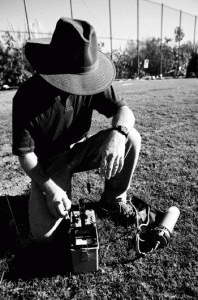
In direct response to a five-year CityBeat and EnviroReporter.com investigation into a biomedical nuclear waste dump in Brentwood, the Veterans Administration has begun testing soil and groundwater on its West Los Angeles property. The surprise decision was announced last week. The first phase of testing began November 30 at the Barrington Recreation Center with surface soil inspection, and adjacent arroyos were also included, covering 27 acres of the VA site. The second testing phase will take place this spring and will involve borings as deep as 80 feet into the earth to sample for radiation and chemical contamination.
The results of the phase-one “walkover survey” will be revealed in late January by Millennium Consulting Associates, the company hired to do the testing. The Los Angeles Times reported that it would cost the VA $78,500 to complete phase one and credited the move to recent stories about the park. “The dumping was largely forgotten until earlier this year when reporter Michael Collins, writing for the alternative weekly Los Angeles CityBeat and EnviroReporter.com, raised new concerns about the dump area,” the Times wrote November 30. A nuclear watchdog group, Committee to Bridge the Gap, warned of the dump’s dangers in the early 1980s but failed to elicit subsequent action.
Exclusive 2019 Update: VICTORY AT THE VA – West LA Veterans Administration master plan protects old nuclear dump from development
Citybeat’s investigation revealed that, from (1948) to 1968, the VA and UCLA dumped radioactive and chemical waste, much of it irradiated animal carcasses and ashes, under property that is now part of the Barrington Recreation Center, dog park, and adjacent arroyo, as well as Brentwood School’s athletic field. Materials including radioactive tritium, or “heavy water,” as well as carbon-14 with a half-life of 5,730 years, were buried in barrels or sloshed in trenches along with the toxic chemicals toluene and dioxane. Though VA officials and others have long denied any hazard, shards of radioactive glass were found in one of the arroyos that registered over four times normal background radiation levels.
Testing of the property comes after months of negotiations between the VA and L.A. City Councilman Bill Rosendahl, whose district abuts the VA. Initially, the VA discounted the investigation, claiming that it had proven that the site was safe beyond any reasonable doubt. However, the councilman wanted more assurances and wrote to VA Secretary James Nicholson on June 13.
“Well, I’ll be very candid with you,” said Rosendahl as we walked through the dog park on the first day of testing. “Your article raised a lot of questions for me and until those answers come, I’m not comfortable. That motivated me to meet with them [VA], talk to them, get answers from them, and I was not satisfied. That’s when I decided to send a letter to Washington, which in some cases is like a shot over the bow, to get everybody’s attention which we explained to local folks: ‘It had nothing to do with you, it has to do with the past and it has to do with safety and health.’ When they understood that, they weren’t as contentious with me as they were when I sent the letter to Washington. Their big question was: ‘Why Washington? Why didn’t you come to us?’ The answer was pretty simple: Washington calls the shots.”
Those shots could be heard at a Brentwood community meeting November 27 when Millennium president Michael Noel explained the testing program to about two dozen residents, government officials, and media. “I want this to be absolutely transparent,” said Noel, who will lead the survey. “It’s an open book. If we find anything that was a potential health issue, a glaring issue that maybe would necessitate closing facilities or doing something else, it would absolutely be brought forward to the VA immediately and, I’m sure, to the councilman directly.”
Noel, a military veteran whose professional experience includes working on the five-year decommissioning of the Rancho Seco nuclear power plant near Sacramento, detailed the survey, which is unprecedented in Los Angeles. Groundwater migration on and off the site will be analyzed as well as potential “capillary action,” which is the upward migration of radionuclides to the soil surface.
“I feel that we have a consultant in place who knows what he’s doing,” said Rosendahl. “He’s absolutely going to be thorough. He’s going to do every inch of this property, even those that weren’t even discussed before. Secondly, when he does the heavy part of the investigation which will be March and April, and he does these bores that go down as deep as 80 feet, we’ll know a lot more.”
Already, some new information has come to light. Prior to walking over the site, Noel had the grassy vegetation of the arroyos shorn to the nub, revealing the precise contours of the land. Visible there were several mounds that might be evidence of waste burials not previously marked in a part of the dump known as area “A.”
Pre-1980 and 1995 maps of the dumping grounds, drawn from the recollections of VA personnel, show this area being in the arroyo southeast of the dog park and northwest of the Brentwood Theatre. At least 18 similar piles, resembling oversized burial mounds lined up in a row, sit along the arroyo. They match the maps for area A and were pointed out by Noel on the November 30 field inspection.
Not all information about the dump will be so readily attainable. Last year, contractor PricewaterhouseCoopers published a report stating that radioactive waste and asbestos-containing material were buried under 15-to-30 feet of fill under the Brentwood School athletic field. That report was analyzing the property for potential development, but the VA refused to divulge where the contractor had found this information, stating by way of explanation that “the technical nature of some of the subject matter made a written response less satisfactory and likely to raise more questions.” The VA also criticized the PricewaterhouseCoopers’s response for making “wrong assumptions.”
Rep. Henry Waxman (D-Los Angeles), the soon-to-be chairman of the House Committee on Government Reform, requested the same information in a March 27 letter to VA Secretary Nicholson and was told he’d get it in August. Waxman is still waiting and it appears that Noel won’t have much better luck. “I have read the report,” said Noel at the community meeting. “No, I don’t have any additional information and in trying so far to get to that source, I’m reaching a lot of blind alleys.”
Noel’s quest hasn’t ended at the VA, a point he made clear at the meeting. He is reaching out to government officials, the press, and any agency that might have relevant information. “I want to get to the bottom of this, put it to bed, and have the community say ‘we accept that,’ and go on,” said Noel.
Michael Collins and extensive documentation of this investigation, including photographs, maps, and official reports, can be reached at EnviroReporter.com.
Exclusive 2019 Update: VICTORY AT THE VA – West LA Veterans Administration master plan protects old nuclear dump from development






Recent Comments