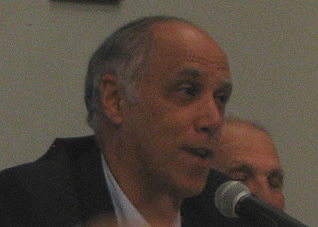
 The Joan Trossman Bien Miller-McCune Interview with Committee to Bridge the Gap’s Dan Hirsch – July 8, 2009
(Bien conducted this interview as part of our co-bylined August 24, 2009 Miller-McCune article “50 Years After America’s Worst Nuclear Meltdown – Human error helped worsen a nuclear meltdown just outside Los Angeles, and now human inertia has stymied the radioactive cleanup for half a century.”)
Daniel O. Hirsch has been the president of the Santa Cruz-based Committee to Bridge the Gap (CBG) for the last 39 years. The nuclear watchdog organization has been instrumental in the uncovering and addressing contamination at Boeing’s 2,850-acre Santa Susana Field Laboratory (SSFL) in the hills between the Simi and San Fernando valleys.
“We have been exposing this cozy relationship between government and polluter, in the process creating significant public pressure to alter the associated policies that place the public’s health at a very low priority,” the CBG’s website says. “Our method of operation is to identify “force multipliers,” so that we (and those who support us) get as much “bang for the buck” as is humanly possible, given the powerful and well-funded forces we oppose.”
In 1979, a UCLA student was assigned to supervise Hirsch’s organization as part of his duties as staff of the Community Services Commission at UCLA. That student, Michael Rose, espied an activist pamphlet in CBG’s then-Los Angeles office that made mention of the meltdown. Rose’s discovery would change Hirsch’s life and the nuclear history of Southern California.
Bien spoke with Hirsch on July 8, 2009 about the 1959 meltdown of the Sodium Reactor Experiment (SRE) and other issues related to the sprawling lab. Following are excerpts of Hirsch’s account:
“After Boeing denied and denied that the data (wind data) existed [for the SRE in July 1959], and then said if it did exist they wouldn’t release it because they claimed it was proprietary, a trade secret, which is pretty hard to imagine that which way the wind blew is a trade secret.
“The local legislators established something called the Santa Susana Field Lab Advisory Panel in the early 1990s to do health studies related to the field lab contamination. The study that was done initially was of the field workers on the premise that the workers had higher exposure than the public so if the workers were okay, then the public could breath a sigh of relief and if the workers were not okay, then we would try to study the offsite population. So workers wore radiation badges so it was easier to do epidemiological studies than it is for the public which don’t wear radiation badges.
“The panel contracted with a team from the school of public health at UCLA and they studied the workers and found that the workers had increased death rates from key cancers like lung cancer, cancers of the lymph and blood systems, than did workers at the same facility that had lower exposure to the radiation. They found the same thing for the rocket test workers. Those who had more exposure to the rocket tests had more cancers than those who had less exposure.
“That then led to our panel who [sic] had funding from the state legislature to study the offsite population. In that set of studies, we needed to know the wind data. And Boeing refused to release it. So we did the study and the study had to draw more general conclusions, saying if the wind was blowing this way we might have this number of cancers, if it was blowing that way it might be this, producing a range of estimates without being able to specify in more detail.
“After the study came out, members of the state legislature became upset that those data had been suppressed, intervened with Boeing and the DOE, and when the data were discovered to actually exist and demanded that they hand it over. But by that time, our funding was over and we have not now been able to use the data although I’m not sure that it would answer the questions as much as we would wish because the actions occurred over two weeks and therefore you have to know pretty precisely when in that two week period the big releases of radiation occurred. Then you had to figure out when the wind was blowing and the data are not good enough now to know when they were releasing and what they were releasing. So there are still some big unknowns.
“I was teaching at UCLA in 1979 right after the Three Mile Island accident and students wanted to research nuclear activity in Los Angeles to see if there was any nuclear facilities and whether they had had any problems. The students, relatively quickly, found a reference in a study done by another group in the mid-70s that had a few notes referring to a fuel damage episode at the Santa Susana facility.
“So I sent the students in to the annex to the UCLA engineering library and they found a series of technical reports that had been prepared for the Atomic Energy Commission by the firm that ran the fuel lab at that time called Atomics International. The reason for this is the man who founded Atomics International and then taught at UCLA arranged for UCLA to get a collection of the technical reports from Atomics International.
“And in those technical reports were a series of reports about the accident. They tell you day by day what happened. So you know that the accident run began on July 12, on the 13th they had a power excursion and barely were able to shut the reactor down, spent a couple of hours trying to figure out what happened and couldn’t figure out what happened, and started it up again. And inexplicably ran it until the 26th of July.
“This was in the face of rising radiation readings and also a scram [reactor shutdown]. Radiation readings were very high, some went off the scale, and eventually it shut down on the 26th and [the reactor personnel] discovered that a third of the core had experienced melting. They finally shut it down because two weeks of high radiation readings eventually sunk in.
“The reactor was designed with a space for radioactive gases to collect above the reactor and then there was no place to put those. They purposely pumped them out of the reactor and into tanks then up the stacks and into the environment. Containment structures are designed to contain the gases, not to pump them out. (Editor’s note – the SRE did not have the containment structure that Hirsch refers to.)
“Understand, the radiation monitors went off scale. They were too hot to measure. We don’t know how much got out because it was too much for the devices to handle. You can’t really reconstruct how much got out into the environment.
“As for the workers who were exposed to high levels of radiation, the government compensation is a long and tragic story. The federal government, in small part, in response to the study that had been done by UCLA in the 1990s of the cancer rate, and also many other studies done by the DOE in other places nationwide, Congress set up a program to compensate nuclear energy workers. But it is in large measure a program run by the very same people who exposed the workers in the first place. So they have resisted tremendously paying out to the field lab [workers], have paid a tiny portion has actually been paid out so far. Like the Atomic Vets, they have stalled it knowing that the person putting in the claim will be dead by the time they have to pay.
“The Santa Susana Field Lab had ten reactors, nine in addition to the one that had the meltdown. And at least three of the others also had serious accidents. In addition to the ten reactors, there was also a Hot Lab, which was designed to cut apart and work on highly irradiated nuclear fuel not just from the Field Lab but shipped in from the DOE and AEC [Atomic Energy Commission] facilities from around the country. And there were numerous nuclear fires and spills and releases from that facility, also.
“They had a plutonium application fuel facility which is perhaps the most dangerous facility they had on the property. And you know how dangerous plutonium is. And lastly, they had a sodium burn pit where they took radioactively contaminated components and illegally burned them in open pits in the open air. So, all told, that produced a substantial amount of radioactive contamination plus chemical contamination from the rocket testing where there was a large amount of traditional chemical contamination.
“So far, considerably in excess of a quarter of a billion dollars has been spent on clean-up and they’re still very, very far away from being able to clean this site up.
“In terms of the buildings themselves, Boeing has torn down most of the buildings. That, in itself, is a controversy. The EPA demanded that they be able to inspect the buildings themselves before they were torn down to make sure they had been cleaned up. When the EPA arrived on the appointed day, three of the five buildings they were supposed to study had been already torn down, including the SRE.
“And some of the debris from those buildings was taken to the Bradley Municipal Landfill, which is just a regular municipal trash facility. And others went to the Calabasas and Sunshine landfills and the radioactive metals went to a metal recycler in the Long Beach area and got melted down into metal products. So your zipper or belt buckle or earrings may be radioactive.
“As for the clean-up, they haven’t begun the chemical clean-up and they are hoping to have accomplished part of it by 2017 which would be 60 years after the contamination started. The radioactive cleanup – they’ve torn down many of the buildings and many remain but the cleanup of the soil essentially has not begun yet either. The U.S. EPA is supposed to be doing a radiation survey to find the contamination, and that will take a couple years, and then there will be an environmental impact statement and hopefully they will commence the cleanup. The reason for that is the DOE and Boeing wanted to walk away from the contamination. They had decided they would leave 99%, by their own admission, of the radioactively contaminated soil in place and walk away. So we went to court and got the court to order them not to do that.
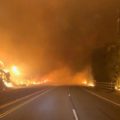
“When there is a brushfire in the area, it is a potential concern. The radioactivity and chemicals in the soil are brought up into the vegetation and in some cases, they concentrate dramatically in the fire, so when the fire burns, the vegetation can be burning, the contaminated vegetation which then can be dispersed in the air. The wind can carry it far from the site.
“You know the old saying, ‘Those who cannot remember the lessons of the past are condemned to repeat them, and repeat them, and repeat them, and repeat them.’ People today are not remembering what happened the last time we went deeply into nuclear power. We had meltdowns and horrible accidents that we are spending billions of dollars unsuccessfully trying to clean up.
“I’m deeply troubled that the Obama administration has very strong ties to the nuclear industry [though the] Illinois utility and that the administration is essentially undermining everything in the pilot bill, everything by throwing in a revival of nuclear proliferation. If they go the way they are going, we are going to end up drowning both in global warming and in plutonium. It’s a tragedy because this could be the point where we really solve the global warming problem and do so without proliferating nuclear weapons.
“Nuclear power spreads nuclear weapons. You can’t have one without the other. So at the very same moment that we say we’re concerned with the Iranians enriching uranium for their nuclear power program, we are trying to expand our own nuclear activity where we are trying to stop theirs. North Korea who process spent fuel trying to get plutonium so they can get the weapons [sic], we say that’s horrible and at the same time the legislation that is going through Congress now would end a 30 year moratorium on reprocessing in the United States is in place because of the proliferation thing.
“I think what we’re doing is extraordinarily shortsighted. And as much as I had hopes for Obama as everyone else does, I’m fearful that the two worst presidents may end up being George W. Bush and his successor. First, because of the Iraq War and the economy.
“We have a climate bill that is so watered down that it won’t have much effect on global warning at the same time he is supposedly addressing the second must dangerous problem that the world faces, global warming, by exacerbating the biggest problem we face.
“Global warming is an existential threat to the planet. I think that history may be very critical in a way that the general public nowadays does not contemplate because Obama is so personable and popular. Similarly, trying to reduce global warming while at the same time trying to increase the number of nuclear weapons in ways that we can’t deal with and the risk of meltdowns which can kill hundreds of thousands of people, I think that history will judge that very poorly.”




Recent Comments