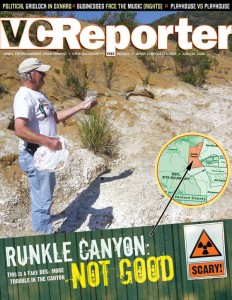
 Runkle Canyon’s Chromium Conundrum
By Michael Collins
Ventura County Reporter – June 26, 2008
The men had been up that hot dusty trail before, high in the hills above Simi Valley. Hawks flew overhead as vernal pools evaporated in the late March heat. Tracks of critters led to the stream that still had an oily sheen to it as it did in May 2007. That’s when these two “Radiation Rangers,” self-styled concerned Simi Valley citizens, had the water tested and found heavy metals including arsenic at high levels. Their findings were later confirmed by tests conducted by the City of Simi Valley.
The Rev. John Southwick and Frank Serafine climbed higher into the lush chaparral, back to recon the canyon for any changes before a community meeting March 27 about the neighboring 2,850-acre Santa Susana Field Laboratory, or Rocketdyne as the field lab is typically called. The lab’s soil and groundwater are heavily polluted by radiological and chemical toxins as well as heavy metals. The troubled property has an 11-acre drainage that runs down from its nuclear testing area into Runkle Canyon.
Rocketdyne is currently the object of a cleanup that could last years and cost hundreds of millions of dollars. The lab suffered two meltdowns, one of which in 1959 released much more radiation than the more infamous Three Mile Island meltdown did in Pennsylvania in 1979. Numerous spills, accidents and illegal burning of radioactive and chemical detritus from the Cold War-era lab qualified it in 2007 for EPA Superfund status.
Superfund is EPA’s program to identify, investigate and remediate the worst hazardous waste sites in the country, currently numbering more than 1,200, with approximately 70 percent of the cleanup activities paid for by the responsible polluting parties, which in Rocketdyne’s case means the Department of Energy, NASA and Boeing.
KB Homes, based in Los Angeles, hopes to build 461 homes in Rocketdyne-adjacent Runkle Canyon. The Radiation Rangers have been fighting the development for nearly two years over concerns that the land has been polluted by the lab and would be unsafe to build on. The Rangers maintain that high levels of leukemia-causing strontium-90 found in Runkle Canyon soil, first reported in the VC Reporter more than three years ago [See cover: “Which Way the Wind Blows,” Feature, 3/17/05], came from Rocketdyne.
But even with everything they thought they knew about the canyon, nothing prepared them for what they were about to witness: Rounding a corner in Runkle Canyon, they came upon a sea of white rocks and powder covering vast expanses of the canyon, and where there once had been sage and scrub there now was a sizable white dead zone.
“This stuff is everywhere,” Southwick said. “It looks like it snowed in Runkle Canyon!”
What the men didn’t know was that the white rocks they would collect were loaded with chromium, a heavy metal that usually exists in two forms, including hexavalent chromium, which oozed into the national consciousness with the 2000 film Erin Brockovich. They also didn’t know that when the government’s own tests of the mysterious stuff came back, officials would dismiss it as harmless without determining the makeup of the chromium. As disturbing as this new dead zone in Runkle Canyon appears, it also appears to be precipitating to the surface in another canyon on the other side of
Rocketdyne in the San Fernando Valley.
Snow Job
This isn’t the first time the residents have had to take things into their own hands. Last year, Southwick and fellow Rangers Patty Coryell and Terry Matheney shouldered the financial burden of testing the land and surface water for heavy metals that the developers didn’t. Those tests yielded worrisome results. That helped lead to an April 14 voluntary cleanup agreement between KB Homes and the Department of Toxic Substances Control, which at this point consists of inspecting information. The Cal-EPA department, also charged with overseeing the cleanup of Rocketdyne, is currently reviewing Runkle Canyon environmental reports supplied by KB Homes, and other tests, data and analysis from the Rangers and this reporter.
That night at the Simi Valley Cultural Arts Center, Serafine and Southwick huddled with the department’s project director for Rocketdyne, Norm Riley, at the Rocketdyne meeting. Riley agreed to take the sample for analysis.
“Norm remarked, ‘Can I take this on the plane?’ and we laughed about it,” Southwick said. “Norm was in very good spirits that evening, very friendly. He later commented that he had seen this substance ‘all over the place’ up in Runkle. We were so encouraged that he took the stuff to be looked at.”
“We are interested in knowing the identity of the white material on the surface of the rock,” Riley wrote in an April 16 e-mail to Morgan Hill-based laboratory TestAmerica. “We suspect it is probably a metal salt of some kind, e.g., calcium sulfate, sodium carbonate, or potassium phosphate, but we do not know.”
Oddly, in an e-mail by the toxic substance control department geologist Gerard Abrams to Riley two weeks before the sample was sent to the lab, there was a notation that a department scientist had already concluded that “the white precipitate is an evaporative salt.”
So when Riley sent the TestAmerica report to Serafine, it seemed a foregone conclusion that this strange landscape of evaporate was no more significant than, say, a salt-encrusted dry stream in Death Valley. But the numbers tell a different story.
Chromium Canyon
Several of the heavy metal levels in the white-encrusted rock tested by the department were notable when compared with what is considered the definitive California soils background data from the March 1996 Kearney Foundation of Soil Science special report authored by the Department of Soil and Environmental Sciences, University of California, Riverside and the Department of Toxic Substances Control.
This apparent “evaporative salt” contained just 14 percent more sodium, or salt, than average California soil, but the potassium was more than 635 times normal. While the calcium content was a relatively minor 31 percent higher than normal, nickel was nearly 11 times normal, molybdenum more than 14 times the typical background, and iron an amazing 3,243 times its average concentration in California soil.
Most troubling is the chromium reading of 1,300 milligrams per kilogram. That amount is more than six times the U.S. EPA Region 9’s “preliminary remediation goal” for the metal in soil, a level where no more than one in a million cancers form in people from a particular pollutant. The sample amount is also nearly 11 times normal chromium soil concentrations in the state.
Establishing chromium standards has been the subject of fierce debate especially since the film Erin Brockovich, which centered on the discovery of hexavalent chromium in the groundwater of the tiny California town of Hinckley. Indeed, chromium, which has been known to cause cancer, has fouled the groundwater underneath the eastern part of the San Fernando Valley including the cities of Burbank and Glendale.
The city of Simi Valley’s Tetra Tech analysis of samples drawn from Runkle Canyon surface water in its creek last summer found that chromium was detected at 20 percent higher than the state’s “maximum contaminant level” for tap water. While Runkle’s water is not directly consumed, it does flow downhill into the Arroyo Simi aquifer under the city, which is used to blend with imported water and makes up 20 percent of the mix.
The levels of chromium found in Runkle Canyon, which had been overlooked as toxic, far exceed healthy standards set by Kentucky, New Jersey New York, Oregon and even Canada.
Rocketdyne Chromium
If chromium is moving off the lab into the canyon below, it may be traveling through the groundwater aided by the Burro Flats Fault, which transverses Rocketdyne and curves into Runkle as it turns northwest toward Simi Valley and the Arroyo Simi aquifer.
An analysis called “Soil Background Report, Santa Susana Field Laboratory,” was created by the environmental firm MWH for Boeing, NASA and the Department of Energy in September 2005 to determine, in part, the soil background comparison levels for metals up at the lab. According to the report’s numbers, Runkle Canyon’s chromium is more than 35 times Rocketdyne’s average with nickel clocking in at more than 23 times and molybdenum at about 3.8 times Rocketdyne’s background.
“If the metal concentration in the investigational unit data exceed the soil background comparison value, further evaluation will be necessary to determine whether site characterization is complete,” the report reads. “As discussed with Department of Toxic Substances Control, this includes evaluating other site information (historical operations, sampling data trends, and risk assessment findings) in a best professional judgment [sic] approach to making decisions regarding additional sampling needs (DTSC 2005).”
Indeed, not only are the chromium, nickel and molybdenum Runkle Canyon results from the mysterious white evaporate significantly more than background values on heavily polluted Rocketdyne, they also trip the Department of Energy’s “preliminary action level” for total chromium in an “industrial” setting of 64 mg/kg. The Runkle result is more than 20 times this limit even though the energy department standard is for industrial settings which, as a rule, have less stringent limits than residential and parkland scenarios like the canyon.
So will the super high hits of these heavy metals in Runkle Canyon get that necessary “further evaluation”? Recent statements by a toxic substances control representative indicate that it will not.
Here, There and Everywhere
At the following Rocketdyne Workgroup meeting in Simi Valley on June 26, a resident spoke during public comment about what he had found three weeks earlier in Dayton Canyon in the western San Fernando Valley. That man was Dave Carey, who lost a brother to cancer that he blames on Rocketdyne’s pollution.
Carey related that he saw a white evaporate, including white rocks, all along the upper reaches of the creek running through the property, some of which he had collected. He wanted to know what this new stuff was and if the department would test it, according to Adam Salkin, who filmed the meeting and transcribed excerpts of it.
“This is Dayton Canyon — it’s a fresh salt, and I’m more than willing to show you guys where this is,” Carey said. “I had an emergency room doctor who accompanied me on this hike and saw this salt. My mother was there who saw this salt. I have it right here in my car in a box. Why isn’t the department sampling this and how come other previous samples that I’ve given to your staff weren’t sampled to find out what this salt is?”
Jim Pappas, the toxic substance Chief of Northern California Permitting and Corrective Action Branch, sat in on the workgroup panel for Norm Riley, dismissed Carey’s concern. His response suggests, however, that what is in Runkle Canyon is in Dayton Canyon, too.
“I’m familiar with your request about the salts, and we have sampled the [unintelligible] salts found on the rocks of Dayton— and the concern was … we looked for it for perchlorate and the samples for perchlorate came up ‘non detect,'” Pappas said. “We were in Runkle Canyon and observed a similar kind of salt — a crystal on the rocks there, too, and had it analyzed and although they were different drainages obviously we checked the precipitate salt and found that it wasn’t a problem to public health.”
“I’d be more than happy to share with you the analytical results of our previous investigations,” Pappas continued. “In Runkle there were some metals and some calcium and other salts but it wasn’t, uh, we didn’t find it a problem for public health.”
“I nearly fell out of my seat when I heard Carey say that he found the same thing in Dayton Canyon that we did in Runkle Canyon, which is miles away on the other side of Rocketdyne,” Southwick told the Reporter after the meeting.
“But what really upset me was Pappas just dismissing the finding out of hand and saying the substance was some harmless stuff no one should be concerned about.
“While it is laudable that the department would test the rock with white precipitate out of Runkle Canyon and then give the Radiation Rangers the results, it is unfathomable that these folks didn’t see that the stuff has so much chromium and is obviously not natural — just look at it!” Southwick said. “I am completely discouraged because we have so much faith in Norm Riley. That chromium has to be broken down to see what it is exactly. And with what the Rangers and the city found last year with the arsenic and heavy metals, the department has to take this stuff as seriously as we do and get the science right.”
Days before the last Workgroup meeting, Serafine and Southwick again journeyed up Runkle to take more photos of the chromium-containing canyon and to collect samples to test, if needed.
“When we returned to Runkle Canyon in June, we found large quantities of the white powder,” Southwick said.
“Walking on it gave me the feeling of walking on fresh snow — it had a definite crunch to it. It seemed to be a very bright white in the sunshine.”
The numbers of what composes the white substance are also glaring but you wouldn’t know it from the government agency in charge of investigating Runkle Canyon. This will be little comfort to the residents of Simi Valley who drink the water that flows down that canyon into their aquifer. The Radiation Rangers, armed with their own hard-earned expertise and ample samples of the precipitate, are determined not to let possible chromium contamination go unnoticed.
Article Sidebar – “Toxicity Standards Elsewhere”
Other states have standards that prompt further investigation triggered by specific total chromium concentrations in soil. The New Jersey “soil action level” for chromium is 100 mg/kg, which the Runkle Canyon sample exceeds by a factor of 13. The state’s soil action level for nickel is also 100 mg/kg which the Runkle sample exceeds by more than six times.
New York’s objective for total chromium is 10 mg/kg (or background) meaning that the Runkle sample is 130 times that. Kentucky’s objective for total chromium is 21.3 mg/kg (or background) which the white evaporate is 61.03 times more than. The Runkle Canyon chromium reading is 30 percent higher than what Oregon’s maximum allows in a residential soil scenario.
Canada’s total chromium set of standards for agricultural andrresidential/parkland are both 64 mg/kg, which Runkle’s reading exceeds by more than 20 times. The country’s soil quality guidelines for hexavalent chromium for both agricultural and residential/parkland are both 0.40 mg/kg. If Runkle Canyon’s chromium reading is from this deadly kind of chromium, Cr (VI), it would be 3,250 times Canada’s limit for the carcinogen.
24 Years of Award-Winning SSFL/Rocketdyne Reporting
June 1998 – June 2022





Recent Comments