 One of the most puzzling aspects to the astronomical pollution problems at Boeing’s Santa Susana Field Laboratory, has been ‘how could they have spilled that much goo’? Trichloroethylene, monomethylhydrazine, perchlorate, nitrogen tetraoxide, dioxins, polyaromatic hydrocarbons – the list seems endless.
Of course, as our reporting on the former Rocketdyne lab shows, radioactive and chemical waste was burned, buried and spilled inadvertently and on purpose. In Area IV of the lab, workers drew lots to see who would get to shoot at barrels of radioactive sodium floating in a contaminated pool.
Sometimes the results were disastrous such as in 1994 when two Rocketdyne scientists were blown apart. The tragedy resulted in a $6.5 million fine being levied against the company in 1996.
We’ve known that between 530,000 upwards to a million gallons of the rocket engine solvent trichloroethylene has fouled the groundwater at the lab and is spreading in several directions. There used to be an “air-stripping” charcoal tower system that could clean up to 10 gallons of TCE out of the groundwater a year until Boeing turned it off several years ago.
Even if it were active, it would still take over 50,000 years to clean the groundwater of the TCE alone. But the system sits idle while Boeing has argued that since no one will use the contaminated groundwater because it is contaminated, it shouldn’t have to clean it up. That argument hasn’t washed with the community.
Rocketdyne began to recycle most of its TCE from 1964 on instead of letting it sluice into so-called “ponds” at the base of the test stands after using the solvent to clean out both the internal and external components of rocket engines being “hot-fired.” That knowledge, however, doesn’t entirely solve the solvent and rocket fuel-corrupted groundwater mystery.
Rocket test stands are already front and center for contamination assessment. Some community members want the test stands left in place for a future park honoring the aerospace work done at Rocketdyne; others contend that the test stands will probably have to go if the land is to be cleaned up so it’s safe for future generations.
EnviroReporter.com has uncovered information that may unravel the riddle of why there is so much goo in the lab’s groundwater and explain the intense toxicity of the land around the rocket test stands on the 2,850-acre property in the hills between the Simi and San Fernando valleys.
The revelation comes in a passage from the 2006 “Rocketdyne: Powering Humans into Space” by for Rocketdyner Robert S. Kraemer on page 37:
“VTS-1 [Vertical Test Stand 1] had been built with steel support structures built above a towering concrete base so that there would be a great distance (about 80 ft) from the rocket nozzle exit to the ground. It came as a surprise that, even with that distance to dissipate the exhaust, it was chewing away at the rock base at a great rate. A concrete deflector was tried, but it rapidly spalled away under the intense heat and pressure. Even when a steel bucket was installed at the base, the exhaust was rapidly eroding the steel. Following a suggestion by Jim Benson, a member of the test crew, a massive shower of water was injected into the exhaust, and the erosion problem was finally solved.”
Gigantic rocket test exhaust plumes were hosed down to prevent them from melting the land beneath them, inadvertently washing untold amounts of unburned toxic exhaust down into pools down-gradient from the test stands.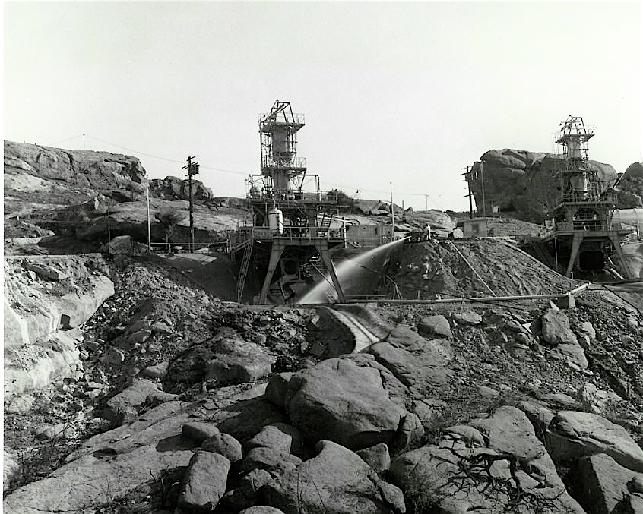
Some of these ponds lead to the headwaters of the Los Angeles River. Contaminated plume water percolated into the lab’s groundwater which shows signs of polluting areas as far away as Simi Valley with detections of the rocket fuel oxidizer perchlorate five miles from the lab.
Kraemer doesn’t speculate on whether this method of cooling off the toxic exhaust would impact the environment. The former head of Rocketdyne’s Advanced Design in the 1950s and early 1960s doesn’t address pollution problems at the lab even though the site is undergoing characterization and remediation that is expected to cost hundreds of millions by cleanup target date 2017.
Can a “massive shower of water” actually wash contaminants into pools below? That would depend on the type of fuel being used.
“The toxins and everything we’d dump down The Hill and the stuff they used to vent everyday was unbelievable,” former Rocketdyne worker Jim Economopoulos said in an interview for our article “Sins of Rocketdyne.”
“There wasn’t a day gone by when we weren’t venting something into the air. We used to test the directional rockets for the Space Shuttle. There were two types of fuels: hydrazine and hydrogen tetroxide [an oxidizer]. We’d fire the rockets, and they’d just vent thousands of gallons of this stuff up into the air. We didn’t have hazardous- materials outfits – just hard hats and overalls. We used to walk through clouds of this crap all the time.”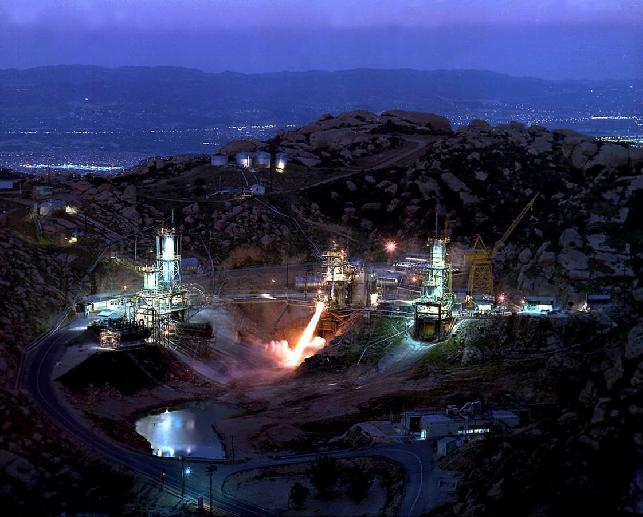
Economopoulos eventually sued over disabilities he says came from his time on The Hill where he says he was accidentally sprayed with TCE, soaking up to his knees. His maladies include pancreatic problems, diabetes right after working at Rocketdyne and eventually multiple myeloma, or bone cancer.
“I thought I was doing something for the country, but I didn’t know I was killing myself. If I had known that…,” Economopoulos said, and then broke off in a painful silence in a 2003 interview.
“All hydrazines are carcinogens,” former Rocketdyne scientist William Webber said in an interview in 1999. “The other half of the propellant team, which is the oxidizer, is nitrogen tetraoxide, and it is a very volatile liquid. As soon as it spills, it oxidizes and turns into a heavy gas. A heavy gas, if it gets in your lungs, forms nitric acid and nitrous acid. It inflames the lungs, and what kills you is flooding of the lungs — the same action the war gas phosgene does. If you get a heavy dose, you can be dead in a matter of minutes.”
According to Webber, the same kind of gases that hosed down for perhaps decades with no thought of the environmental consequences, are toxic enough to incapacitate and kill. “We used to use that stuff like water.”
But will spraying water through the exhaust plumes of rockets, over 30,000 of which were fired off at Rocketdyne, precipitate toxins out of the smoke and flames? Does the exhaust itself, seen for years by astonished residents in the towns below, contain the same kind of poisonous rocket fuel ingredients or do they vaporize off?
The answer is both according to Frederick S. Simmons of the Aerospace Corporation who wrote the 2000 book “Rocket Exhaust Plume Phenomenology.” The toxic fuels used in rocket tests don’t fully combust, according to Simmons, in this book that addresses rocket exhaust signatures in a war scenario but which are applicable to tests ignited at Rocketdyne.
“[T]here are other sources of inefficiency,” Simmons wrote. “These include viscous boundary layer losses, kinetic losses in the chemical reactions themselves, particulate drag losses, and losses in energy release caused by nonideal vaporization and mixing on a small scale. However, the most significant departure from the idealized flow as described above is consequent to two effects: the unmixedness of the reactants in the combustion chamber and, in the case of liquid propellants, incomplete vaporization.”
Simmons suggests that large droplets of fuel exit rocket engines. That would confirm that vast sprays of water could wash the so-called “witches’ brew” of rocket fuel contamination into the otherwise usually parched Simi Hills.
That’s a whole lot of goo. Now we know that a common sense suggestion by a Rocketdyne crew member in the early 1950s may have inadvertently helped further destroy the land and subsurface water which feeds the Los Angeles River.
It remains to be seen if this will concentrate cleanup around the test stands necessitating their removal. But thanks to Kraemer’s book, one key piece of the puzzle of Rocketdyne’s polluted past has come to light: rocket exhaust was hosed down and a slush of poison sluiced into the San Fernando Valley and eventually percolated into the lab’s groundwater giving rise to the term goo.
This goo won’t be easy to clean up with Boeing doing everything in its power to torpedo the State’s order to clean up the place to the highest standards. Years of hosing rocket exhaust led to years of hosing a public exhausted by decades of dealing with unrepentant polluters. At least with the rocket test stands, the community now knows where the hosing came from.
25 Years of Award-Winning SSFL/Rocketdyne Reporting
1998 – 2023










As an unwilling recipient of the fallout from an Ares test firing plume, I need help. I need to connect with people who have a working knowledge of the chemistry involved in the plumes from rocket test firing and in modeling the fallout range, please help! Email me at pollutionconcern@hotmail.com Thank you.
Thanks for your good deductive investigation expanding our knowledge of previous procedures and sources causing such extensive watershed and aquifer contamination. Mentioning the Los Angeles River as downstream recipient is still rare in most public media, thank you for linking it. I’d add that according to an EPA document around 90% of the total SSFL property is also the Bell Creek watershed. So a lot of ‘goo fortified’ surface water trickles and flows from outfalls and under the SSFL fencing to form Bell Creek in the Bell Canyon community, through four L.A. city parks, and past numerous households in West Hills and Canoga Park before becoming the L.A. River. In my experience seeing its name in print or search results is minor so far. When you have time and space any ‘Bell Creek Goo-ology’ worthy of EnviroReporter coverage would be appreciated.
We mistakenly neglected to allow comments on this blog post so please excuse our oversight which has now been corrected.
But, more importantly, did we jump to any conclusions regarding the use of water to hose down rocket exhaust in the so-called “flame bucket” that we write about here?
No, thank goo-ness.
The above passage about Rocketdyne worker Jim Benson coming up with a way to solve the flame bucket degradation problem documented events at the Santa Susana Field Laboratory circa 1950. But was this system to cool down the hot zone under the test stands used past that time or was it a temporary measure used at the dawn of the Cold War?
A passage in the same book, “Rocketdyne: Powering Humans into Space,” confirms that this practice was continued for decades. We derive this conclusion from the following passage excerpted, in part, on page 219 of this excellent book:
“On April 7, 1982, Engine 2013 test 901-364 was planned as a 500-second FPL flight mission simulation test. At 362 seconds the engine was destroyed by a failure which originated in the HPFTP turbine. The engine was burned and ripped out of the test stand. It was found 100ft. away from the base of the test stand, in the spillway built for the flame bucket coolant water.” (Our emphasis)
This means that Rocketdyne used this method to cool off the thousands of rocket engine exhaust flames for at least 32 years and probably for the life of the rocket testing facility that ceased in 2006, according to the report “Historical resources survey and assessment of the NASA facility at the Santa Susana Field Laboratory, Ventura County, California,” released by Archeological Consultants, Inc. and Weitz Research in March, 2009.
56 years of hosing down the goo that has resulted in a grossly polluted facility that the land owner, Boeing, still is fighting to not clean up to standards mandated by state law.
And now, 60 years later, some community activists maintain that the rocket test stands should stay standing despite the now-obvious conclusion that they are the center of the chemical pollution that plagues the facility.
How the remediation of Rocketdyne, estimated to cost up to a billion dollars, can take place without excavating the area around and under the stands without the structures coming down has not been answered.
It seems unlikely that the community activists demanding that the rocket test stands stay in place have a solution for this vexing problem. And it seems unlikely that long-time community activists fighting for the cleanup of the lab since 1989 will settle for leaving polluted places at Rocketdyne intact simply to satisfy the whims of preservationists.